William Rice (b. 1816) and Mary Mahon – A Family Rooted in Ballycoyle, County Wicklow
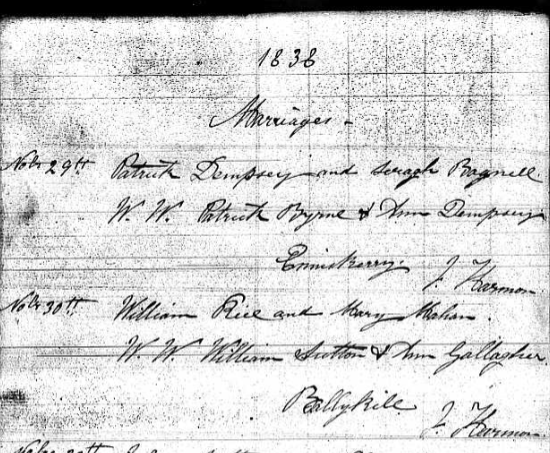
William Rice, born circa 1816, married Mary Mahon in November 1838 at Enniskerry, County Wicklow. Their recorded residence at the time of marriage was Ballycoyle (also known as Ballykile), a rural townland in the Upper Glencree Valley. The marriage was witnessed by William Sutton and Ann Gallagher, confirming the event as a documented and verifiable point of origin for the Rice family in this region.
While their marriage is certain, the exact dates and places of birth for both William and Mary remain uncertain. Ongoing research suggests that Mary Mahon may have been born around 1818 in Dunlavin, County Wicklow, the daughter of John and Elenor Mahon. However, this connection, while plausible, is not yet definitively established.
Baptismal Records of the Children of William and Mary Rice
Thanks to well-maintained parish baptism records from the period, the birth of their children can be clearly traced:
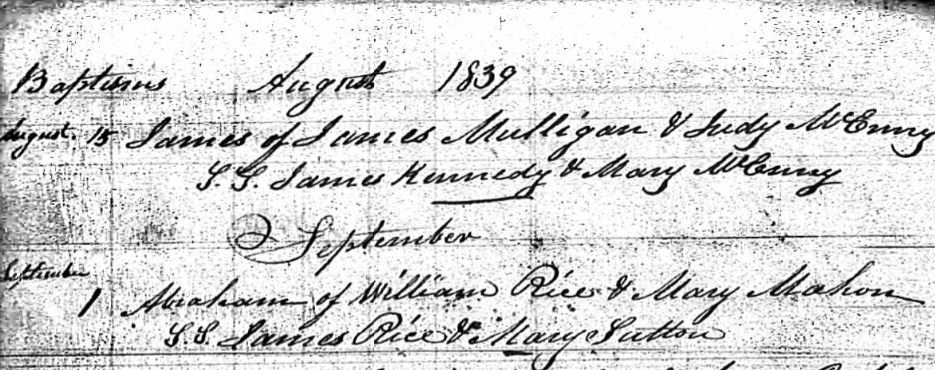
- Abraham Rice – Baptised in September 1839. Godparents: James Rice and Mary Sutton.
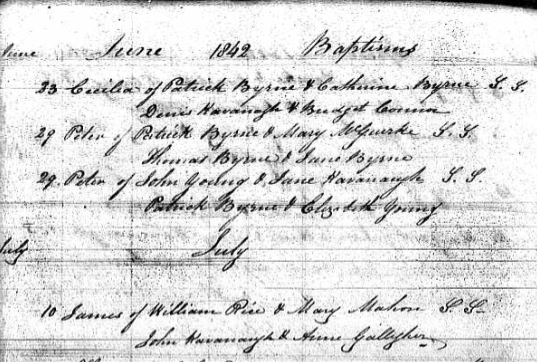
- James Rice – Baptised in July 1842. Godparents: John Kavanaugh and Anne Gallagher.
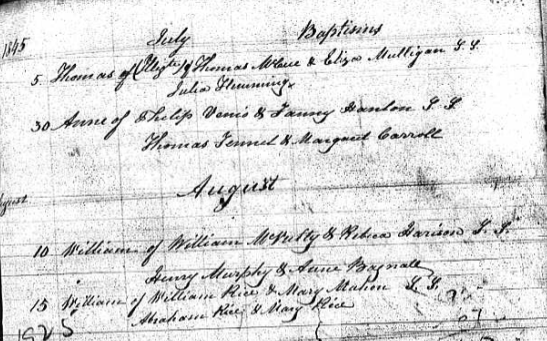
- William Rice – Baptised in August 1845. Godparents: Abraham Rice and Mary Rice.
- Peter Rice – Baptised in April 1848. Godparents: James Mahon and Ellen Gallagher.
- Bridget Rice – Baptised in May 1853. Godparents: Patrick McGuirk and Bridget Mahon.
- Sarah Rice – Baptised in April 1856. Godparents: Edward Mahon and Ellen McGuirk.
These entries strongly affirm the family’s continuing presence in the region through the mid-19th century and point to close ties with other local families, including the Mahons, McGuirks, Gallaghers, and Suttons.
A Glimpse into the Glencree Valley and Ballycoyle
The Rice family lived in what was then a challenging but strikingly beautiful part of County Wicklow—Upper Glencree. Three hundred years ago, this area was largely uninhabited. The land was steep, rocky, and forested with dense groves of native oak, earning the valley its Irish name meaning “Valley of Trees.”
By the early 19th century, population pressures and the enclosure of land by large landowning families—most notably the Wingfields of the Powerscourt Estate—pushed landless tenants further into the upper reaches of the valleys. Here, small plots were carved from the wooded slopes. Trees were cleared, stones were laboriously removed, and the land was enclosed by the now-iconic Wicklow dry-stone walls.
Settlements emerged in tiny pockets like Ballyleron, Ballycoyle, Cloon, and Tonygarrow. Each family might hold only one or two fields, with rights to shared upland grazing and turf-cutting on common bogs. As the estate developed, the Powerscourt landlords built basic two- or three-room cottages for their tenants. Cobblestone lanes and open drainage ditches followed, bringing a measure of order and permanence to these marginal holdings.
A turning point in the valley’s history came in 1858 when the military barracks at the head of Glencree was handed over to the Oblate Brothers. The brothers converted the site into an industrial school, which became home to over 200 boys and a significant source of employment and activity in the area for more than 80 years. The presence of the school provided a measure of economic stability for struggling families like the Rices during the second half of the 19th century.
Later reforms brought by the Irish Land League gave tenant families greater security and control over their homes. Many took steps to improve their holdings, building outhouses and replacing thatched roofs with slate or tile. Roads to Dublin and Enniskerry were gradually improved and tarred, heralding the arrival of motor vehicles and further integration into the national economy. However, the closure of the reformatory in 1940 dealt a heavy blow to the area. While afforestation brought some employment, hill farming continued to offer only a meagre living.
Why “Aurora”? A Curious Name in an Irish Landscape
Most of the townland names surrounding the Glencree River are of Irish origin—Ballycoyle, Cloon, Tonygarrow—reflecting centuries of Gaelic habitation and tradition. However, just west of the Glencree River, a curious name appears on the map: Aurora, a Latin word and the name of the Roman goddess of the dawn.
Legend has it that an earlier Lord Powerscourt, perhaps returning from a night of revelry at the infamous Hellfire Club, arrived at the ridge above Glencree just as the sun rose over Barnamire Hill. Struck by the spectacular burst of light illuminating the valley below, he named that corner of his estate “Aurora” in honour of the goddess of sunrise. The name, though un-Irish in origin, was a poetic tribute to the natural beauty and spiritual atmosphere of the high valley.
Across the river lies Old Boleys, another townland rooted in the rhythms of rural life. The word boley (from the Irish bó, meaning cow) referred to a summer pasture. This area, with deeper soil and southern exposure, was used for grazing Lord Powerscourt’s cattle each summer—a tradition that continued for generations.
 RICE MUSINGS